
How to make a 12-month cash flow forecast for a bank loan
Build a 12-month cash flow forecast a UK lender will take seriously: assumptions, payment timing, VAT and tax bills, and the checks to run first.
· 5 min read
Ask almost any UK lender for a business loan, from a high street bank to the government-backed Start Up Loans scheme, and you will be asked for a cash flow forecast. It is the document that answers their real question: can this business make the repayments, every month, even when things go a bit wrong?
A forecast is not the same as a profit and loss account. A business can be profitable on paper and still run out of cash because customers pay late, stock is bought upfront or a VAT bill lands in a quiet month. The forecast tracks money actually going in and out of the bank, month by month, for the next twelve months.
What a lender wants to see
Lenders read a lot of forecasts. The ones that inspire confidence share a few traits:
- Twelve monthly columns, starting from the month the loan would be drawn.
- An opening bank balance and a closing balance for each month, carried forward.
- Receipts and payments listed separately, line by line, not just a net figure.
- The loan itself shown coming in, and the repayments going out.
- Realistic assumptions written down somewhere, so the lender can see where each number came from.
- No unexplained months below zero. If the balance dips, show how it will be covered.
Step 1: write your assumptions first
Before you type a single number into the monthly grid, list your assumptions. This is the part lenders question most, so be ready to justify each one.
- Sales: how many customers or units per month, at what average price? Base this on evidence: existing sales, signed contracts, enquiries, market research or the performance of similar businesses.
- Payment timing: do customers pay on the day (retail, cafés) or on 30-day terms (most business-to-business work)? An invoice raised in March on 30-day terms is cash in April at the earliest.
- Seasonality: a landscaper’s year looks nothing like a Christmas gift shop’s. Do not divide annual sales by twelve.
- Costs: fixed costs (rent, insurance, software, phone) and variable costs that rise with sales (materials, stock, card fees, subcontractors).
- Your own pay: drawings for a sole trader, or salary and dividends from a company. Lenders want to see that you can live while the business grows.
Step 2: forecast receipts
Lay out every source of cash coming in:
- Cash sales and card takings in the month they happen.
- Credit sales in the month you expect to be paid, not the month you invoice.
- The loan when it is drawn, and any money you are putting in yourself.
- VAT you collect on sales, if you are VAT registered (it is cash in the bank, even though it is not yours to keep).
- Any grants or other income, only if confirmed.
Be conservative. A lender is far more impressed by a forecast you beat than one you miss.
Step 3: forecast payments
Then every payment going out, in the month it leaves the account:
- stock and materials, remembering any upfront orders before launch
- wages, employer’s National Insurance and pension contributions
- rent, rates, utilities, insurance and subscriptions
- marketing, vehicle costs, professional fees
- equipment and other capital purchases (in full, in the month you pay)
- loan repayments, including interest
- your drawings or salary
Do not forget the tax bills
The months that catch people out are the ones with a tax payment in them:
- VAT: if you file quarterly, payment is normally due one month and seven days after the end of each VAT quarter.
- Self-assessment: sole traders may face payments on account on 31 January and 31 July, on top of any balance due.
- Corporation tax: small companies usually pay nine months and one day after the end of the accounting period.
- PAYE: if you employ people, payments to HMRC are usually monthly.
Put these in the right month, with your best estimate of the amount.
Step 4: let the grid do the arithmetic
For each month:
Opening balance + total receipts - total payments = closing balance
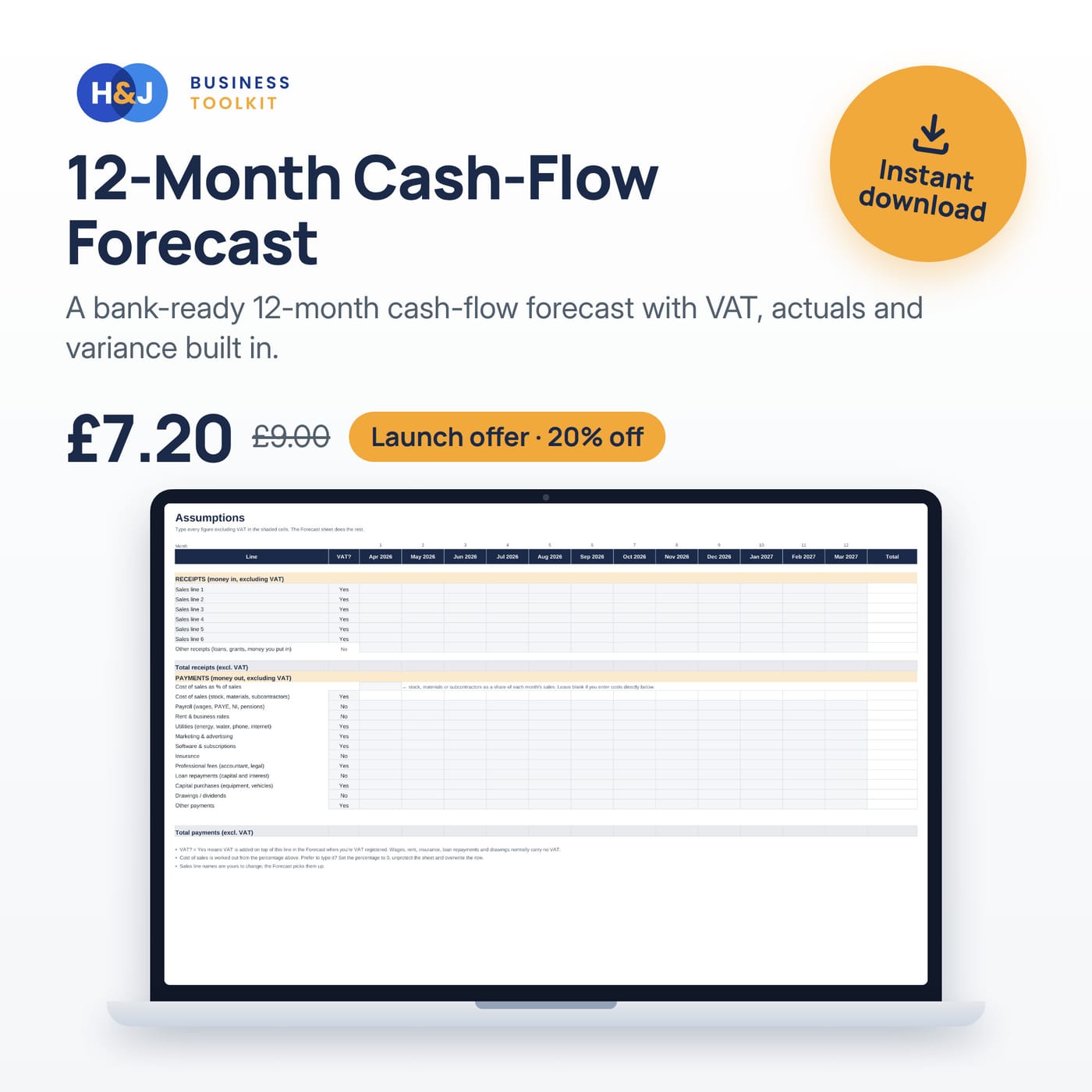
The closing balance becomes next month’s opening balance. A spreadsheet should do this for you; typing totals by hand is where most errors creep in. Our 12-month cash flow forecast template has the formulas built in, adds VAT to sales and VAT-able costs if you switch it on, drops the quarterly VAT payment into the right month and highlights any month that goes negative.
Step 5: stress-test it
Lenders will ask “what if?”, so ask it first:
- What if sales are 20% lower than forecast?
- What if your biggest customer pays 30 days late?
- What if the van needs a £1,500 repair in month four?
If any of these pushes the balance below zero, decide what you would do: an overdraft facility, delaying a purchase, a smaller drawing. Mentioning that you have thought about this in your business plan is a strong signal.
Step 6: compare forecast with actual
Once the loan is in place, the forecast keeps earning its keep. Each month, type in the real figures next to the forecast and look at the difference. If sales are behind, you will know in month two, not month eight, and you can talk to the lender early if you need to. Lenders respect borrowers who spot problems early. A good template has an actuals sheet and a variance sheet for exactly this.
Common mistakes
- Mixing up profit and cash. Depreciation is not a cash payment; a loan repayment is.
- Invoices counted as cash in the month they are sent.
- Forgetting VAT on sales and on costs, or forgetting the quarterly VAT payment.
- Ignoring your own pay.
- A straight line of sales with no ramp-up or seasonality.
- Hiding the bad months. Show them and explain them.
Putting it with your business plan
The forecast rarely travels alone. Lenders usually want it alongside a business plan that explains the market, the competition and how you will win customers, plus a summary of start-up costs. Our business plan template with UK start-up checklist includes sections and tables that line up with the forecast, and if you are already trading, a year of clean records from a bookkeeping spreadsheet gives your assumptions real evidence.
Browse the templates
Templates that help
 Business
12-Month Cash-Flow Forecast
A bank-ready 12-month cash-flow forecast with VAT, actuals and variance built in.
Price: £7.20
was £9.00Launch offer: 20% offExcel · Google Sheets
 Business
 Plan + UK Start-Up Checklist
A full business plan template, a one-page plan and the UK start-up checklist in one download.
Price: £7.20
was £9.00Launch offer: 20% offWord · Google Docs · PDF
 Business
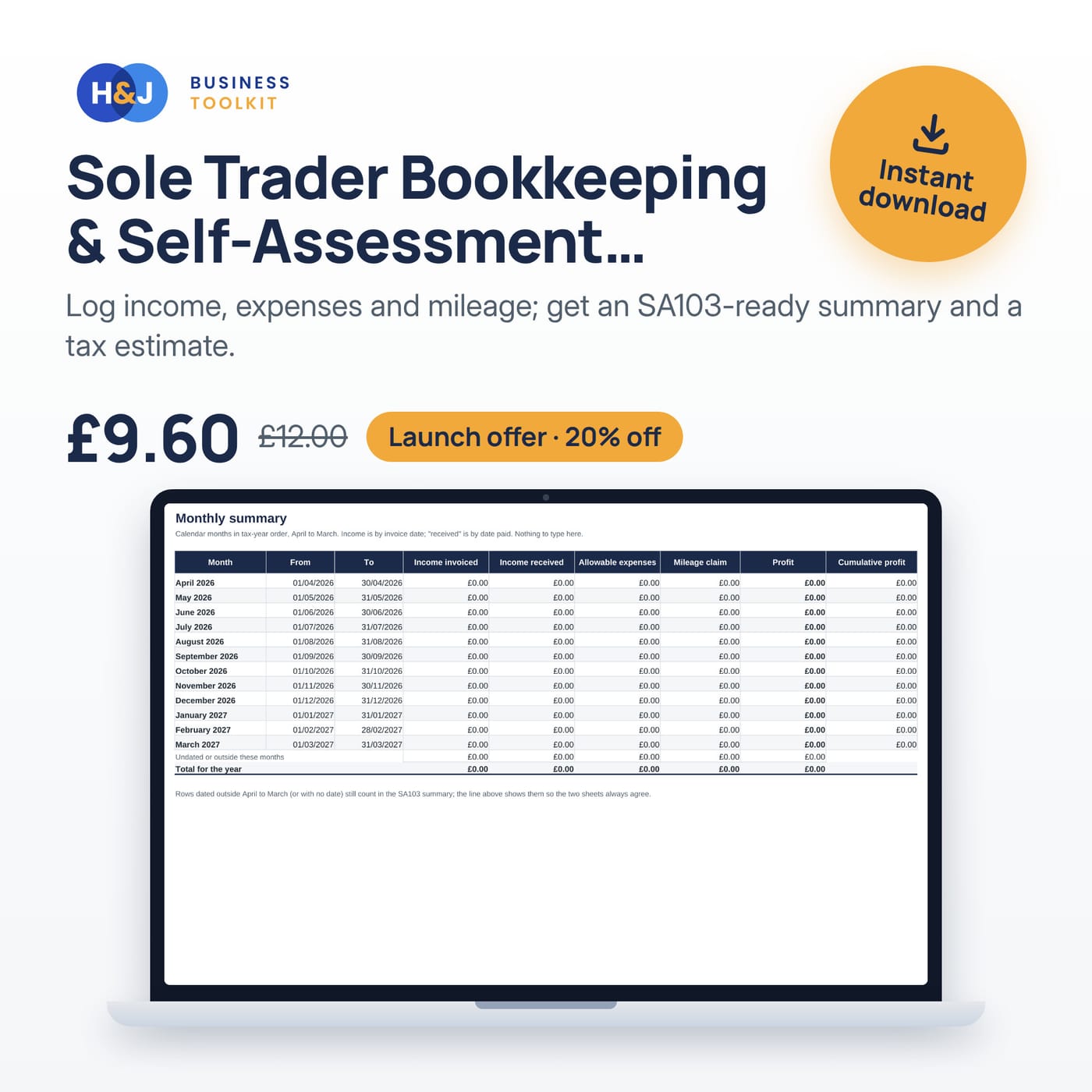
Sole Trader Bookkeeping & Self-Assessment Tracker
Log income, expenses and mileage; get an SA103-ready summary and a tax estimate.
Price: £9.60
was £12.00Launch offer: 20% offExcel · Google Sheets
Keep reading
Sole trader vs limited company: a plain-English comparison
The real differences between trading as a sole trader and running a limited company in the UK — liability, admin, tax, privacy — and how to decide.
Self-assessment expense categories explained
The expense boxes on the self-employment pages of a UK tax return, what goes in each, and the traps that catch sole traders out.
How to invoice as a sole trader in the UK
What a UK sole trader invoice must include, how to number and send invoices, and how to get paid on time.
Get the free invoice template
A clean, UK-ready invoice for Excel and Google Sheets, plus occasional tips and new template news. Unsubscribe any time.
Your template is ready
We have also emailed the link to . Check your spam folder if it does not show up.
Download the template (.xlsx)For Google Sheets: upload the file to Drive and open it with Sheets. Trouble? Email support@hnjuk.co.uk.