
How to invoice as a sole trader in the UK
What a UK sole trader invoice must include, how to number and send invoices, and how to get paid on time.
· 4 min read
An invoice is the document that turns work into money. Get it right and you get paid faster, keep HMRC happy and look like the professional you are. Here is what a sole trader invoice needs, and a few habits that make chasing payments rare.
What a sole trader invoice must include
There is no official HMRC invoice form, but there are things an invoice needs to be valid and useful:
- The word “Invoice” at the top, so nobody mistakes it for a quote.
- A unique invoice number. Use a sequence (INV-0001, INV-0002 and so on) and never reuse or skip numbers. Gaps make bookkeeping and any HMRC enquiry harder.
- Your name and business name (if you trade under one), your address and contact details.
- Your customer’s name and address. For business customers, the company name and the person who ordered the work.
- The invoice date and, if different, the date the work was done or the goods were supplied.
- A clear description of what you supplied. “Bathroom refit — labour, 3 days” beats “Work as agreed”.
- The amounts. Quantity, rate and line total for each item, then the total due.
- Payment terms and how to pay. Due date, bank account name, sort code and account number, or a payment link.
If you are VAT registered you must also show your VAT number, the VAT rate applied to each item, the net amount, the VAT amount and the gross total. If you are not VAT registered, do not mention VAT at all; a VAT-registered customer will otherwise try to reclaim tax you never charged.
Numbering and records
Keep one running sequence for the whole business, not one per customer. Record every invoice in a register with the date, customer, amount, due date and the date you were paid. This is the backbone of your self-assessment figures, and it takes seconds if the register updates itself from the invoices, which is exactly what a decent spreadsheet template does.
HMRC expects sole traders to keep business records for at least five years after the 31 January submission deadline of the tax year they relate to. Digital copies are fine.
Payment terms that actually get you paid
Short terms, stated plainly, work. “Payment due within 14 days” on the invoice and in your quote is reasonable for most small jobs. If you say nothing, the law assumes 30 days for business customers.
For work with materials or a long lead time, ask for a deposit up front. It filters out customers who were never going to pay and covers your outlay.
If a business customer pays late, the Late Payment of Commercial Debts (Interest) Act 1998 lets you charge statutory interest (8% above the Bank of England base rate) plus a fixed compensation amount for each late invoice. You do not have to charge it, but a line on the invoice saying you may is a quiet reminder. This does not apply to consumers, so keep private customers’ invoices free of it.
Sending and chasing
Send the invoice as a PDF on the day the work finishes, while the customer is still delighted. Put the invoice number and amount in the email subject line.
Then follow a simple chase rhythm:
- Two days before the due date: a friendly nudge with the invoice attached again.
- The day after the due date: a short note asking whether there is a problem.
- A week later: a phone call. Most late payments are forgetfulness, and a call clears them.
- Two weeks later: a formal reminder mentioning interest and, if needed, the small claims process.
Keep every message polite and factual. You want the money and, usually, the next job.
Common mistakes
- Rounding and totals that do not add up. Let a formula do the maths.
- Forgetting the due date. “Payment due on receipt” is vague; put a date.
- Missing bank details. The customer has to email you, and the invoice sits in a pile.
- One invoice for several jobs. Invoice each job separately so a query on one does not delay payment of the others.
- No copy kept. Save the PDF and log it in your register straight away.
Make it repeatable
The fastest way to invoice well is to stop writing invoices from scratch. A template with your details, automatic numbering, line totals and a register means each invoice takes a minute, looks identical to the last one and is already recorded for your tax return. Our free invoice template is a good place to start, and the invoice pack adds quotes, multiple designs and a register that tracks who has paid.
Browse the templates
Templates that help
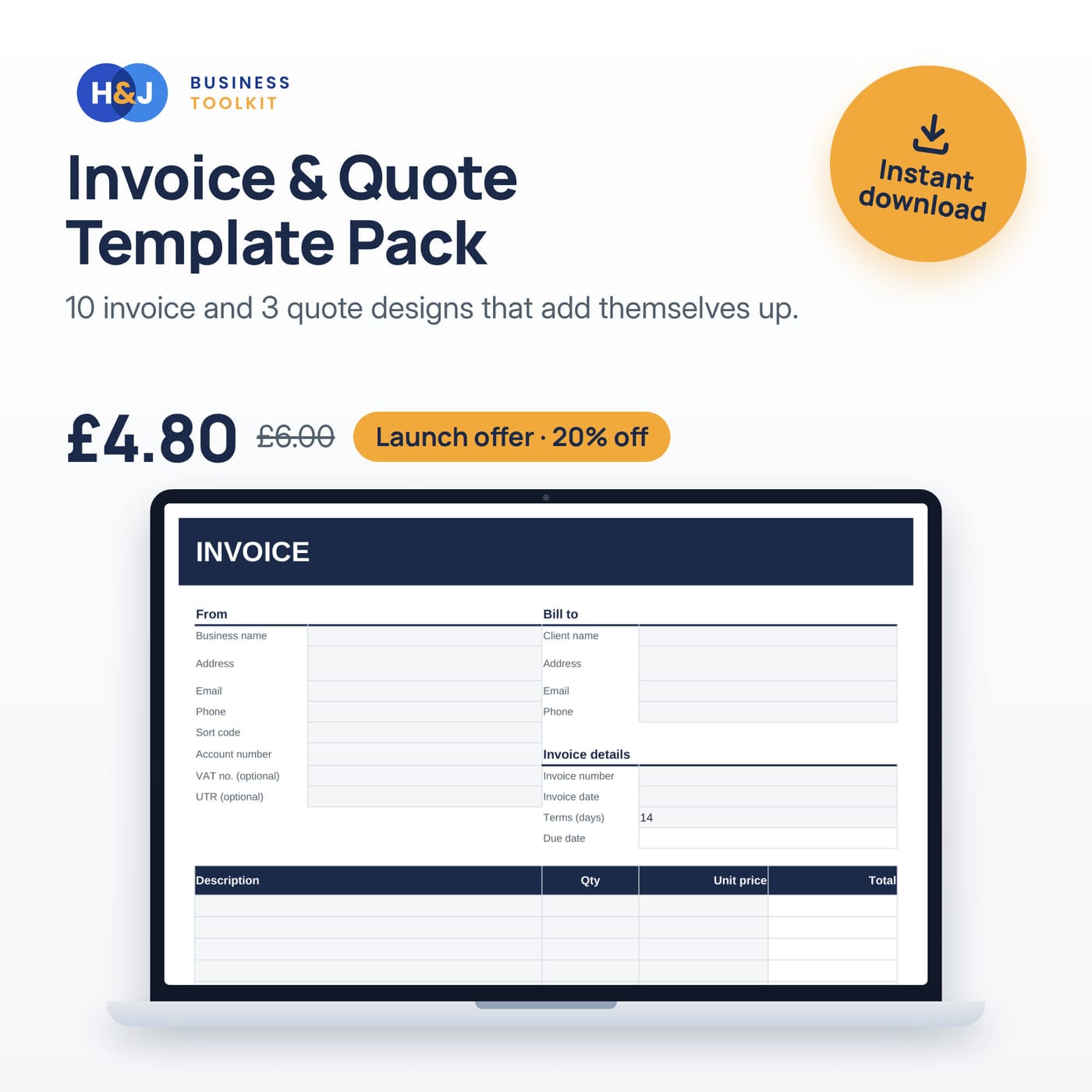 Business
Invoice & Quote Template Pack
10 UK invoice templates and 3 quote designs for Excel, Word and Google Sheets that add themselves up.
Price: £4.80
was £6.00Launch offer: 20% offExcel · Google Sheets · Word
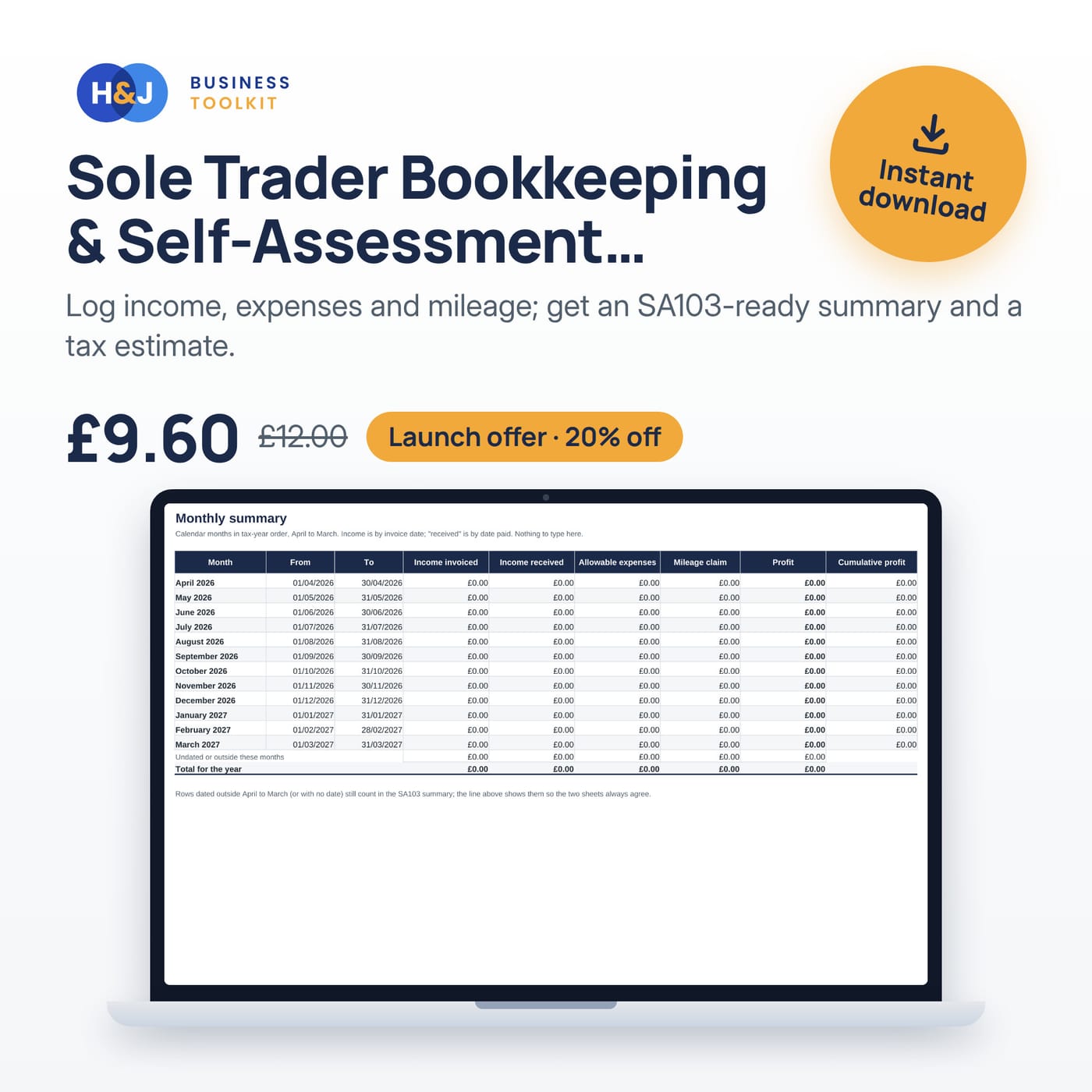 Business
Sole Trader Bookkeeping & Self-Assessment Tracker
Log income, expenses and mileage; get an SA103-ready summary and a tax estimate.
Price: £9.60
was £12.00Launch offer: 20% offExcel · Google Sheets
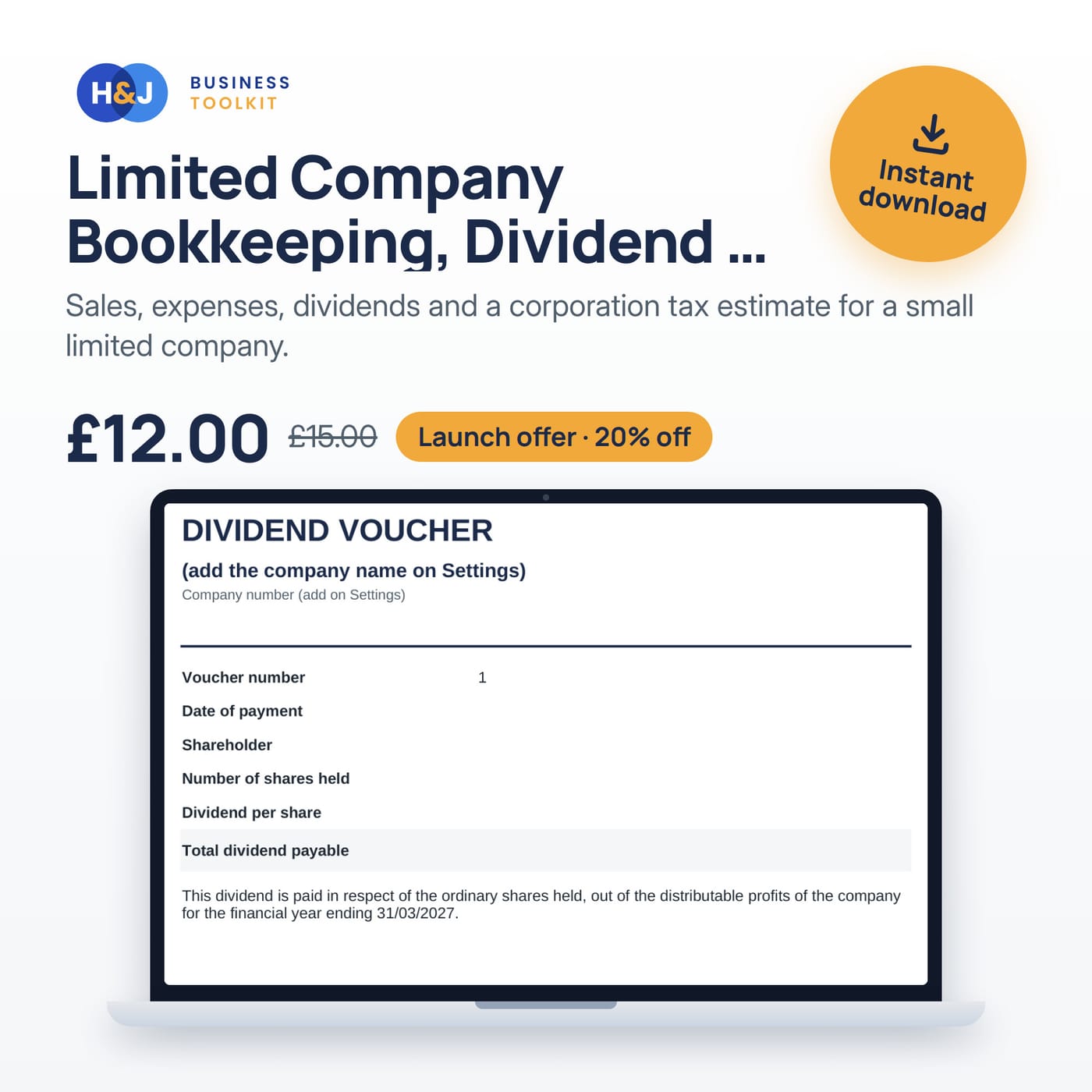 Business
Limited Company Bookkeeping, Dividend & Corporation Tax Tracker
Sales, expenses, dividends and a corporation tax estimate for a small limited company.
Price: £12.00
was £15.00Launch offer: 20% offExcel · Google Sheets
Keep reading
What a limited company must show on its letterhead and invoices
The UK trading disclosure rules in plain English: what a limited company must show on letterheads, emails, websites and invoices, plus VAT invoices.
Sole trader vs limited company: a plain-English comparison
The real differences between trading as a sole trader and running a limited company in the UK — liability, admin, tax, privacy — and how to decide.
How to make a 12-month cash flow forecast for a bank loan
Build a 12-month cash flow forecast a UK lender will take seriously: assumptions, payment timing, VAT and tax bills, and the checks to run first.
Get the free invoice template
A clean, UK-ready invoice for Excel and Google Sheets, plus occasional tips and new template news. Unsubscribe any time.
Your template is ready
We have also emailed the link to . Check your spam folder if it does not show up.
Download the template (.xlsx)For Google Sheets: upload the file to Drive and open it with Sheets. Trouble? Email support@hnjuk.co.uk.