
What a limited company must show on its letterhead and invoices
The UK trading disclosure rules in plain English: what a limited company must show on letterheads, emails, websites and invoices, plus VAT invoices.
· 5 min read
When you set up a limited company, you take on a duty to tell people who they are dealing with. Customers and suppliers are entitled to know the company’s full legal name, where it is registered and how to find it on the public register. These are called trading disclosures, and they apply to your letterhead, your emails, your website and your invoices.
The rules come from the Companies Act 2006 and the Company, Limited Liability Partnership and Business (Names and Trading Disclosures) Regulations 2015. They are not complicated, but they are easy to forget when you design stationery in a hurry.
1. Your registered name, everywhere
The company’s registered name, exactly as it appears on the certificate of incorporation (including “Limited” or “Ltd”), must appear on all of its business documents and communications. That includes:
- business letters and emails
- notices and other official publications
- order forms, quotes and orders for goods or services
- invoices, receipts and other demands for payment
- cheques and other payment documents
- the company’s websites
- applications for licences and any other business correspondence
“Ltd” is an accepted abbreviation for “Limited”. What you cannot do is show only a trading name. If Smith Plumbing Services Ltd trades as “Smith & Sons”, the documents can feature the brand prominently, but the registered name must appear too, typically in the footer.
You must also display the registered name at the registered office and at any place the company carries on business (unless that place is mainly someone’s home), positioned so visitors can easily see it.
2. The extra details for letters, order forms and websites
Business letters, order forms and websites must show four more things:
- The part of the UK where the company is registered: “Registered in England and Wales”, “Registered in Scotland” or “Registered in Northern Ireland”.
- The company’s registered number, the eight-character number Companies House gave you.
- The registered office address. If you use an accountant’s or formation agent’s address as the registered office, that is the address to show, not your trading address (you can show both).
- If the company is exempt from using “Limited” in its name (some charities and guarantee companies are), the fact that it is a limited company.
A typical letterhead footer covers all of it in a line or two:
Smith Plumbing Services Ltd. Registered in England and Wales, company number 01234567. Registered office: 1 High Street, Hereford, HR1 1AA.
Emails count as letters
The regulations apply to documents “in hard copy, electronic or any other form”. An email sent on the company’s behalf is a business letter, so add the same line to every email signature, including the one on your phone. Our Canva brand kit includes email signature layouts with space for it.
Directors’ names: all or none
You do not have to name any directors on your stationery. But if you name any director anywhere other than in the body of the letter or as the person signing it, you must name every director. A letterhead that lists only the managing director breaks the rule.
Share capital: paid up or not at all
You do not have to mention share capital. If you do, it must be the paid-up share capital, not just the amount authorised or issued.
3. What to put on a company invoice
Invoices are business documents, so the registered name is required. GOV.UK’s guidance on invoicing sets out what an invoice should contain, which in practice means:
- the word “Invoice” and a unique, sequential invoice number
- the company’s registered name, address and contact details
- the customer’s name and address
- a clear description of what you are charging for
- the date the goods or services were supplied and the invoice date
- the amounts charged and the total due
- payment terms and how to pay
Because many invoices are sent as letters or emails, and to save any argument about which rule applies, it is sensible to put the full footer from section 2 on your invoices too: registered name, place of registration, company number and registered office. It costs nothing and makes your invoices look established.
If you are VAT registered
A full VAT invoice must also show:
- your VAT registration number
- the time of supply (tax point), if different from the invoice date
- for each line: the quantity, the unit price excluding VAT and the VAT rate
- the total excluding VAT, the VAT rate(s) and the total VAT charged
- any discount offered
There is a shorter simplified invoice for supplies of £250 or less including VAT. When you sell to another VAT-registered business you normally need to issue a VAT invoice within 30 days of the supply. If you are not VAT registered, do not show VAT or a VAT number, and do not charge VAT.
Late payment wording
For business-to-business sales you can add a line referring to the Late Payment of Commercial Debts (Interest) Act 1998, which lets you claim statutory interest and fixed compensation on overdue invoices. You have that right whether or not the invoice mentions it, but saying so tends to concentrate minds.
Our invoice templates include fields for all of the above, a VAT dropdown that switches the VAT lines on or off, and room in the footer for the company details.
What happens if you get it wrong?
Failing to make the required disclosures is an offence for the company and every officer in default, punishable by a fine, with daily fines for continued breaches. In some cases a company that has not disclosed its registered name properly can find it harder to enforce a contract in court. In practice, most problems are found and fixed long before that, but there is no reason to take the risk when the fix is a line of text.
A quick audit
Pull out one of each: a letter, an email from your phone, a quote, an invoice and your website’s footer or contact page. On each, check for:
- the registered name, exactly as on Companies House
- “Registered in England and Wales” (or Scotland or Northern Ireland)
- the company number
- the registered office address
- all directors named, or none
- your VAT number, only if you are VAT registered
If anything is missing, fix the template rather than the individual document, so it never goes missing again. Our business stationery templates and limited company bookkeeping spreadsheet are a good place to start.
Browse the templates
Templates that help
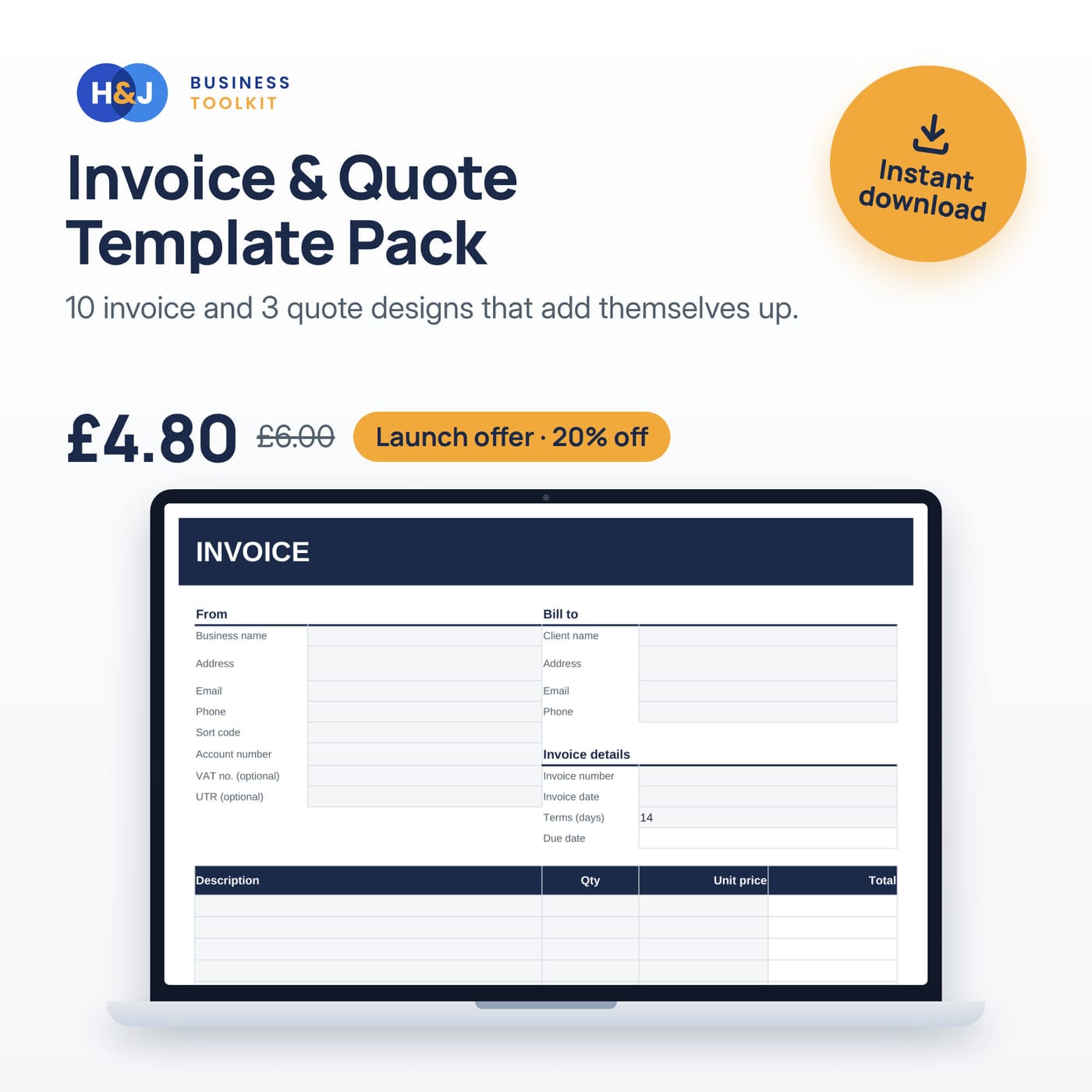 Business
Invoice & Quote Template Pack
10 UK invoice templates and 3 quote designs for Excel, Word and Google Sheets that add themselves up.
Price: £4.80
was £6.00Launch offer: 20% offExcel · Google Sheets · Word
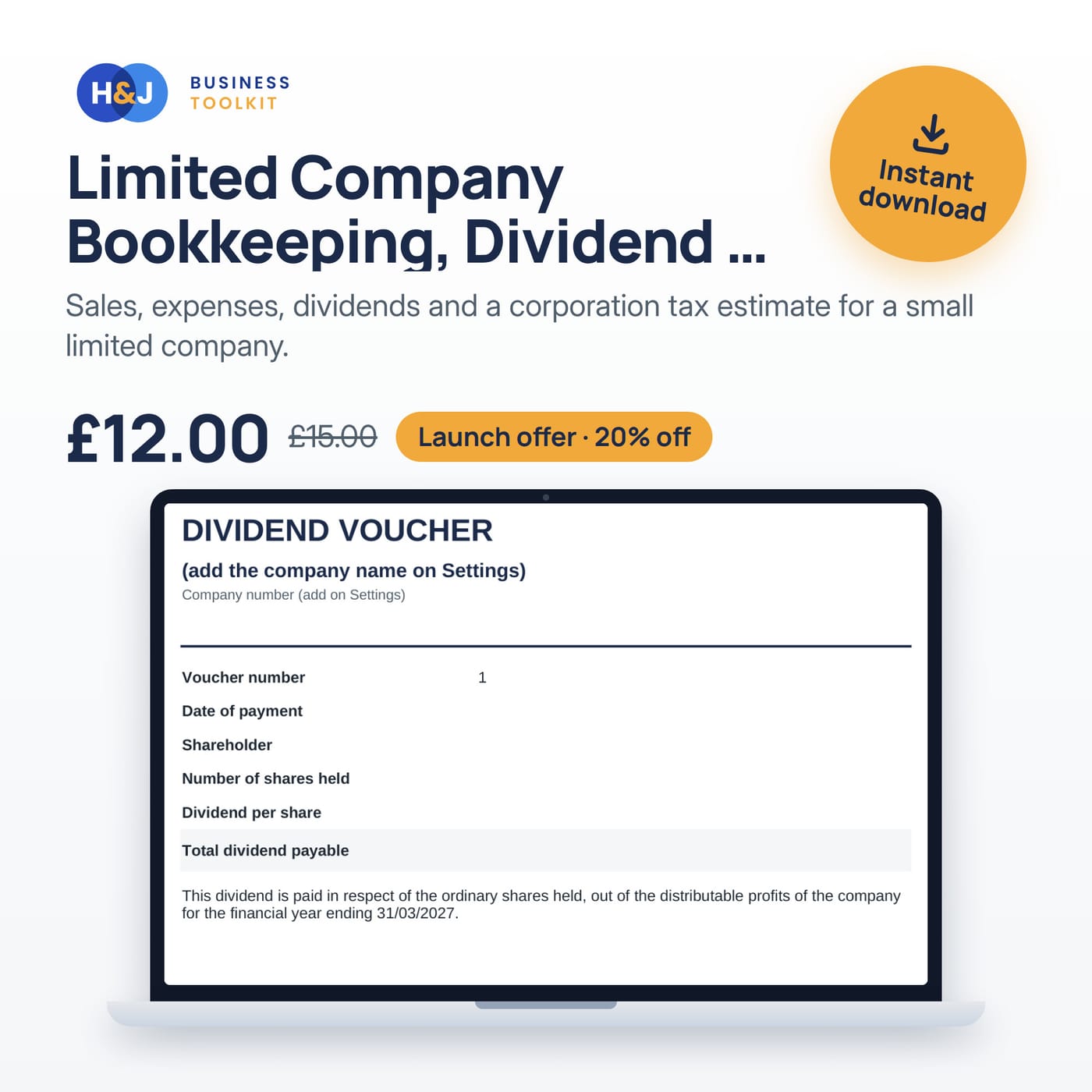 Business
Limited Company Bookkeeping, Dividend & Corporation Tax Tracker
Sales, expenses, dividends and a corporation tax estimate for a small limited company.
Price: £12.00
was £15.00Launch offer: 20% offExcel · Google Sheets
 Business
Canva Brand Kit
Logo, business card, letterhead and email signature in one editable Canva kit, plus a brand guidelines worksheet.
Price: £9.60
was £12.00Launch offer: 20% offCanva template link · Word
Keep reading
How to invoice as a sole trader in the UK
What a UK sole trader invoice must include, how to number and send invoices, and how to get paid on time.
Gift vouchers for small businesses: how to sell and track them
How UK small businesses can sell gift vouchers profitably: what to print on them, fair terms, tracking redemptions, and VAT basics.
Sole trader vs limited company: a plain-English comparison
The real differences between trading as a sole trader and running a limited company in the UK — liability, admin, tax, privacy — and how to decide.
Get the free invoice template
A clean, UK-ready invoice for Excel and Google Sheets, plus occasional tips and new template news. Unsubscribe any time.
Your template is ready
We have also emailed the link to . Check your spam folder if it does not show up.
Download the template (.xlsx)For Google Sheets: upload the file to Drive and open it with Sheets. Trouble? Email support@hnjuk.co.uk.