
Gift vouchers for small businesses: how to sell and track them
How UK small businesses can sell gift vouchers profitably: what to print on them, fair terms, tracking redemptions, and VAT basics.
· 5 min read
Gift vouchers are one of the simplest ways for a small business to bring in cash at quiet times, reach new customers and give regulars an easy present to buy. Salons, cafés, beauty therapists, dog groomers, photographers, driving instructors and garden centres all sell them well, especially before Christmas, Mother’s Day, Father’s Day and Valentine’s Day.
But every voucher you sell is a promise. Done badly, vouchers lead to arguments at the till, double redemptions and a bookkeeping mess. Done well, they are close to free money. Here is how to set them up properly.
Decide what you are selling
There are two kinds of voucher:
- Money vouchers (“£25 gift voucher”) that can be spent on anything you sell.
- Service or product vouchers (“one full set of gel nails”, “a two-hour driving lesson”) for a specific thing.
Money vouchers are flexible and easy to price. Service vouchers often feel more like a present and are easier to sell at a premium, but think about price rises: if a voucher for “a cut and blow-dry” is redeemed after your prices go up, you still have to honour it. Either set a sensible expiry date or word it as a money voucher with a suggested service.
Popular values are round numbers just above your average spend (£25, £50, £75), so the recipient often tops up when they use it.
What to print on every voucher
A professional voucher includes:
- Your business name, logo and contact details, including how to book.
- The value or the service covered, in words someone else will understand.
- A unique voucher number. This is the single most important line.
- Issue date and expiry date.
- Who it is for (optional, but a nice touch) and a space for a message.
- The key terms, in brief: no cash alternative, whether it can be used in part, whether it can be used with other offers, and what happens if it is lost.
- A signature or stamp from you, so a photocopy is easy to spot.
If you trade as a limited company, use the company’s registered name somewhere on the voucher. Our guide to what a limited company must show on its stationery explains why.
Setting fair terms
Write your terms down before you sell the first voucher, and tell the buyer the main ones before they pay. Keep them short and fair:
- Expiry. Six to twelve months is common. Whatever you choose, print it clearly; terms the buyer could not have seen are much harder to rely on.
- Partial use. Either allow balances to carry over (and record them) or state that the full value must be used in one visit.
- Lost vouchers. If you keep a register, you can choose to reissue a lost voucher to the original buyer. Say whether you will.
- Refunds. Vouchers are usually non-refundable once bought, but your normal refund rules still apply to faulty services or goods bought with them.
If you are ever unsure whether a term is fair to consumers, Citizens Advice and the Consumer Rights Act 2015 are the places to check.
Track every voucher in a register
The register is what turns vouchers from a liability into a well-run sales channel. For each voucher, record:
| Field | Why |
|---|---|
| Voucher number | Stops the same voucher being used twice |
| Date sold and buyer’s name | Lets you help if it is lost |
| Value or service | What you owe |
| Payment method | Matches your bank and card takings |
| Expiry date | Tells you what is about to lapse |
| Date redeemed and amount used | What is still outstanding |
| Remaining balance | For part-used money vouchers |
Number vouchers in sequence (GV-0001, GV-0002…) and never reuse a number. When a voucher comes back, find it in the register, check it has not been used and has not expired, then mark it redeemed before you start the service. A spreadsheet is ideal for this; filter on “not redeemed” to see how much you owe in services at any moment.
Selling them
- In person: keep a stack of printed, numbered vouchers by the till, in envelopes.
- By phone or message: take payment by card or bank transfer, then post the voucher or email a PDF.
- Online: sell vouchers as a product on your website or booking system, and email a PDF with the number filled in.
Promote them where your customers already are: a post on social media three weeks before each gifting date, a sign at the counter and a line on your price list. A small bonus (“buy £50, get £5 extra”) can move a lot of vouchers in December, but record the bonus value separately so you know what it cost you.
Bookkeeping and VAT
When a customer buys a voucher, you have their money but you have not yet supplied anything. How that appears in your accounts depends on whether you use the cash basis or traditional accounting, so agree the treatment with your accountant and keep the register as your evidence.
If you are VAT registered, the rules depend on the type of voucher:
- A single-purpose voucher is one where, at the time you sell it, you already know the VAT rate and the place of supply of what it will be spent on (for example, a voucher that can only be used for one standard-rated service in your UK salon). VAT is due when you sell the voucher.
- A multi-purpose voucher is any other voucher, for example one that can be spent on items at different VAT rates. VAT is due when it is redeemed, based on what is actually bought.
If you are not VAT registered, none of this applies, but vouchers sold still count towards your turnover in the normal way. HMRC’s guidance on vouchers (search GOV.UK for “VAT on vouchers”) has worked examples.
Templates to get you started
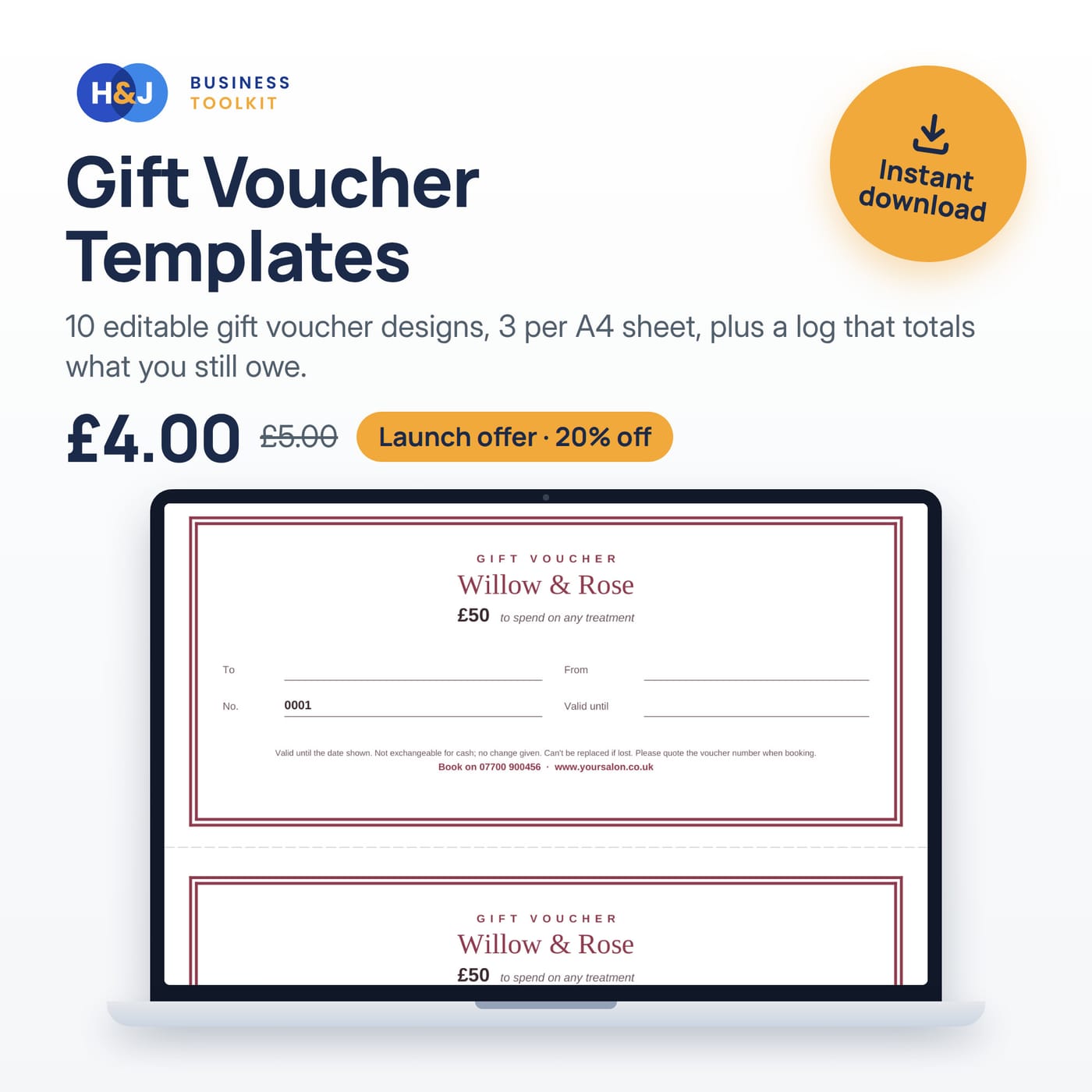
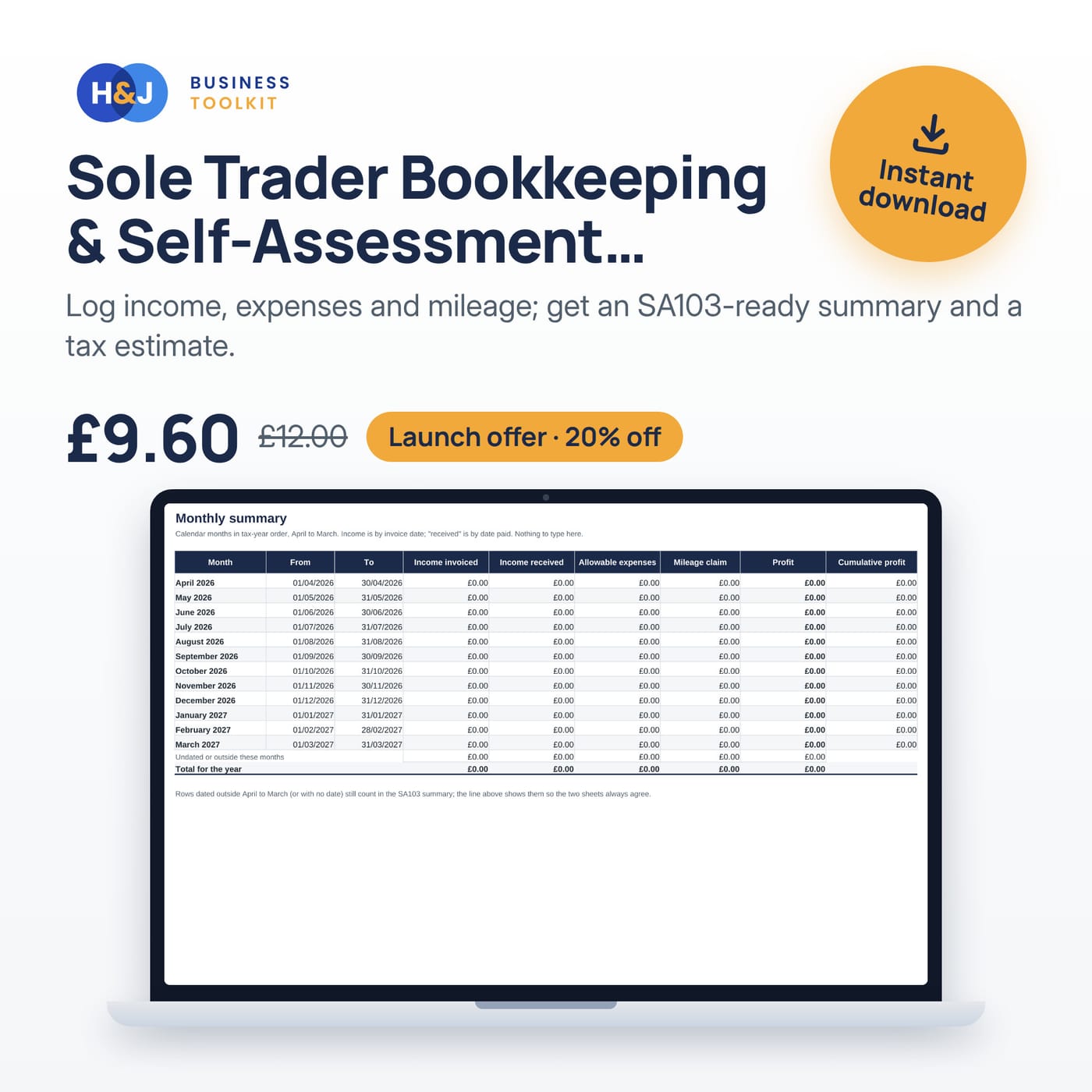
Our gift voucher templates include numbered voucher designs, terms wording and a redemption tracker, and they sit alongside our other business stationery templates. For recording voucher sales with the rest of your income, a sole trader bookkeeping spreadsheet keeps everything in one place for your tax return.
Browse the templates
Templates that help
 Business
Gift Voucher Templates
10 editable gift voucher designs, 3 per A4 sheet, plus a log that totals what you still owe.
Price: £4.00
was £5.00Launch offer: 20% offWord · Google Docs · Excel · Google Sheets
 Business
Sole Trader Bookkeeping & Self-Assessment Tracker
Log income, expenses and mileage; get an SA103-ready summary and a tax estimate.
Price: £9.60
was £12.00Launch offer: 20% offExcel · Google Sheets
 Business
Canva Brand Kit
Logo, business card, letterhead and email signature in one editable Canva kit, plus a brand guidelines worksheet.
Price: £9.60
was £12.00Launch offer: 20% offCanva template link · Word
Keep reading
What a limited company must show on its letterhead and invoices
The UK trading disclosure rules in plain English: what a limited company must show on letterheads, emails, websites and invoices, plus VAT invoices.
Self-assessment expense categories explained
The expense boxes on the self-employment pages of a UK tax return, what goes in each, and the traps that catch sole traders out.
How to make a 12-month cash flow forecast for a bank loan
Build a 12-month cash flow forecast a UK lender will take seriously: assumptions, payment timing, VAT and tax bills, and the checks to run first.
Get the free invoice template
A clean, UK-ready invoice for Excel and Google Sheets, plus occasional tips and new template news. Unsubscribe any time.
Your template is ready
We have also emailed the link to . Check your spam folder if it does not show up.
Download the template (.xlsx)For Google Sheets: upload the file to Drive and open it with Sheets. Trouble? Email support@hnjuk.co.uk.