
UK cover letter tips that actually get interviews
How to write a one-page UK cover letter that answers the job advert: a four-paragraph structure, examples, and the mistakes recruiters spot first.
· 4 min read
A cover letter is your chance to say what a CV cannot: why this job, why this employer, and how your experience fits what they asked for. Recruiters who read them (and many do, especially at small and medium-sized employers) are looking for evidence that you read the advert. Here is how to give them that evidence on one page.
Do you still need one?
If the advert asks for a cover letter, a supporting statement or “a few words about why you are applying”, the answer is yes, and skipping it usually means the application is set aside. If it does not ask, a short letter or a well-written email still helps whenever there is a box for it. Speculative applications, where you write to an employer that is not advertising, always need one.
Keep it to one page
Aim for 250 to 400 words: four short paragraphs on a single side of A4, in the same font as your CV. Put your contact details at the top in the same style as your CV so the two look like a set.
Public sector and NHS applications often use a longer “supporting statement” instead. Those follow different rules: work through the person specification point by point, with an example for each essential criterion.
Who to address it to
Use a name if you possibly can. The advert, the company website or LinkedIn will often tell you who the hiring manager is; if not, a polite phone call to reception is perfectly normal. “Dear Ms Okafor” is better than “Dear Hiring Manager”, which is better than “To whom it may concern”.
The traditional UK sign-off rule is still worth following: “Yours sincerely” when you have used the person’s name, “Yours faithfully” when you started with “Dear Sir or Madam”. “Kind regards” is fine for an email application.
A four-paragraph structure that works
1. Why you are writing
Name the role, where you saw it and one sentence on why you are a strong fit. Skip “I am writing to apply for…” if you can open with something more direct.
I would like to apply for the Office Coordinator role advertised on your website. I have spent four years keeping a busy estate agency running smoothly, and your focus on growing the lettings side is exactly the kind of challenge I am looking for.
2. Why you can do the job
Pick the two or three most important requirements from the advert and give an example for each. This is the heart of the letter. Use specifics: numbers, systems, outcomes.
You mention managing diaries for a team of property managers. At Smith & Lane I coordinated viewings and inspections for six negotiators, cutting double bookings to almost none by moving the team onto a shared calendar with set booking rules.
3. Why this employer
Show you know who they are. Mention something real: a service they offer, their customers, a recent expansion, their values in practice. One or two sentences is enough, and it must be true.
4. Close with a next step
Thank them, say you would welcome the chance to discuss the role, and mention availability if it helps (notice period, start date, interview days).
Tailoring without starting from scratch
You should not write every letter from nothing, but you must not send the same letter everywhere either. Keep a master document with your strongest example for each common requirement (customer service, organisation, teamwork, using a particular system, handling pressure). For each application, copy the letter, swap in the examples that match the advert’s top requirements, and rewrite paragraphs one and three completely.
Matching the advert’s language also helps when applications are screened by software. If they ask for “excellent attention to detail”, use that phrase alongside your evidence rather than “very thorough”.
Mistakes recruiters spot first
- The wrong company name. It happens more than you would think when letters are reused. Read the final version specifically for names.
- Repeating the CV. The letter should add context and motivation, not list your jobs again.
- Talking only about what you want. “This role would be a great step for my career” is about you; turn it into what you will bring.
- Clichés without evidence. “Hard-working team player” means nothing unless an example follows.
- Long blocks of text. Short paragraphs and white space get read; walls of text get skimmed.
- Errors. Use UK spelling, read it aloud, and if you can, ask someone else to check it.
Sending it
Follow the instructions in the advert exactly: an upload, an email or an online form. If you are emailing, attach the letter and CV as PDFs with sensible file names and write a short covering email. If you paste the letter into a form, check the formatting after pasting; bullet points and line breaks often vanish.
Keep a record of each application, the version of your CV and letter you used, the closing date and when to follow up. If you hear nothing within a week or two of the closing date, a short polite email asking about the timescale is perfectly acceptable. A job search tracker makes this much easier once you are applying for more than a handful of roles.
Make the CV match
A strong letter pointing at a weak CV will not get far. If yours needs work, start with our guide on how to write a CV in the UK, and if you want a head start on layout, our CV and cover letter templates are designed as matching sets for Word and Google Docs.
Browse the templates
Templates that help
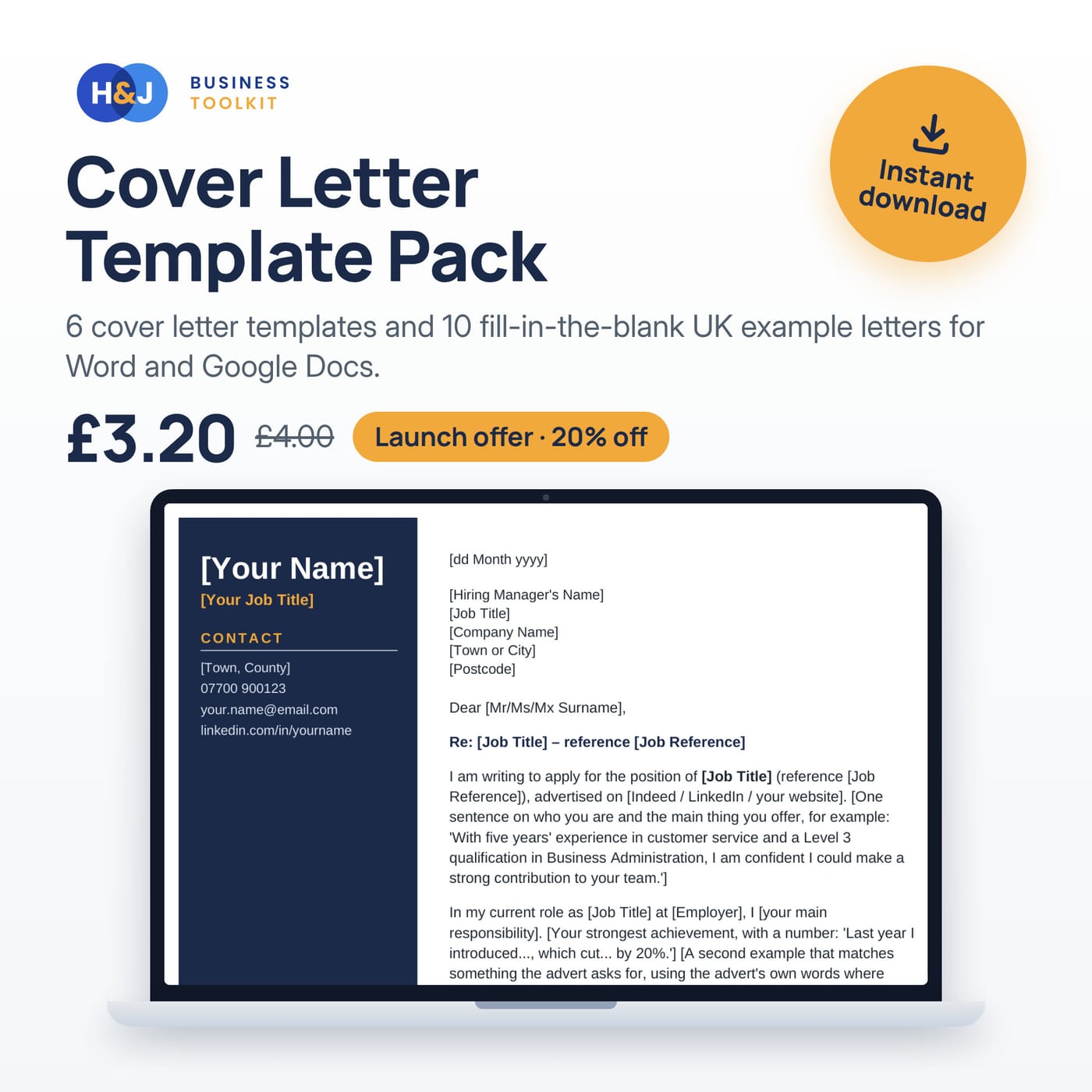 Careers
Cover Letter Template Pack
6 cover letter templates and 10 fill-in-the-blank UK example letters for Word and Google Docs.
Price: £3.20
was £4.00Launch offer: 20% offWord · Google Docs · Pages · PDF
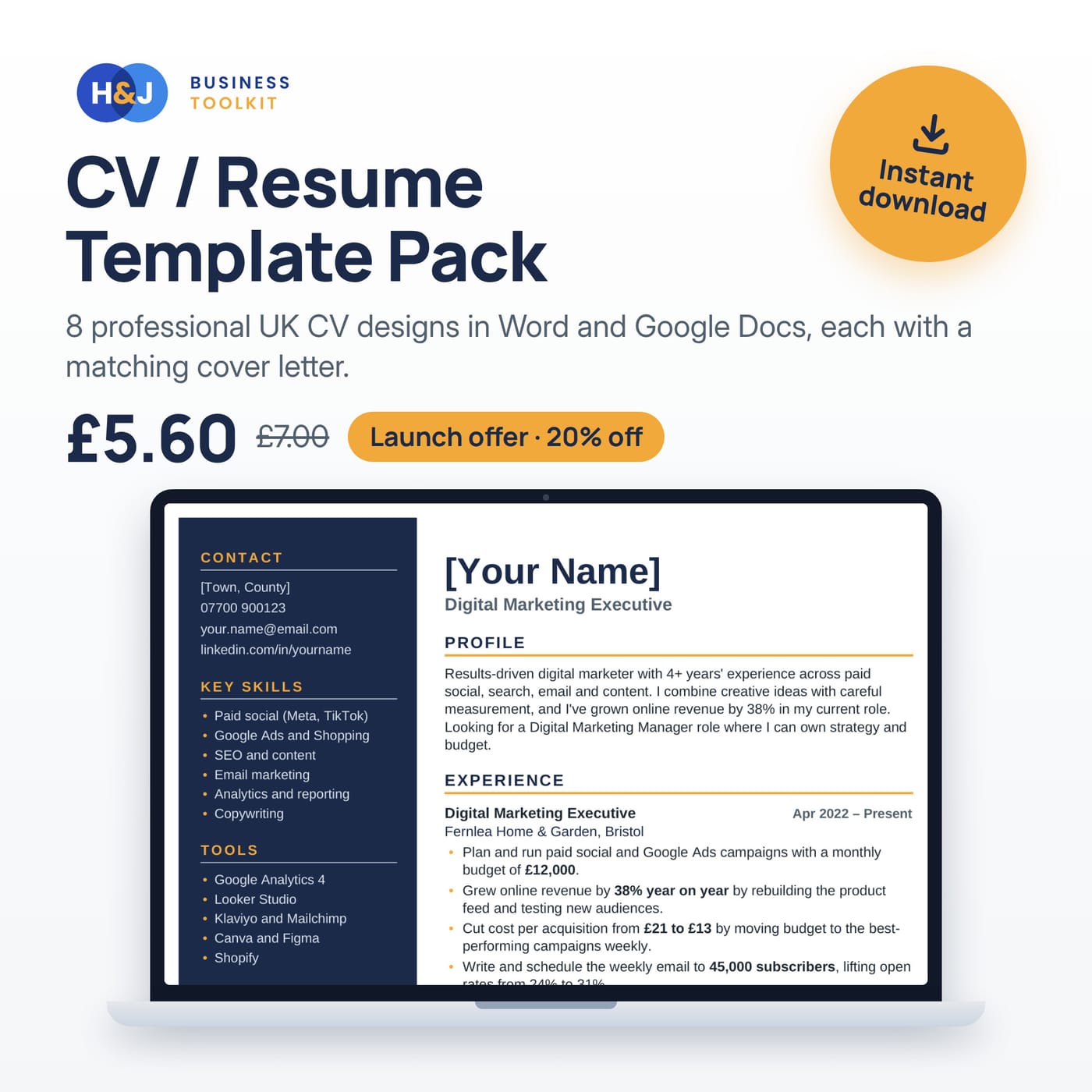 Careers
CV / Resume Template Pack
8 professional UK CV designs in Word and Google Docs, each with a matching cover letter.
Price: £5.60
was £7.00Launch offer: 20% offWord · Google Docs · Pages · PDF
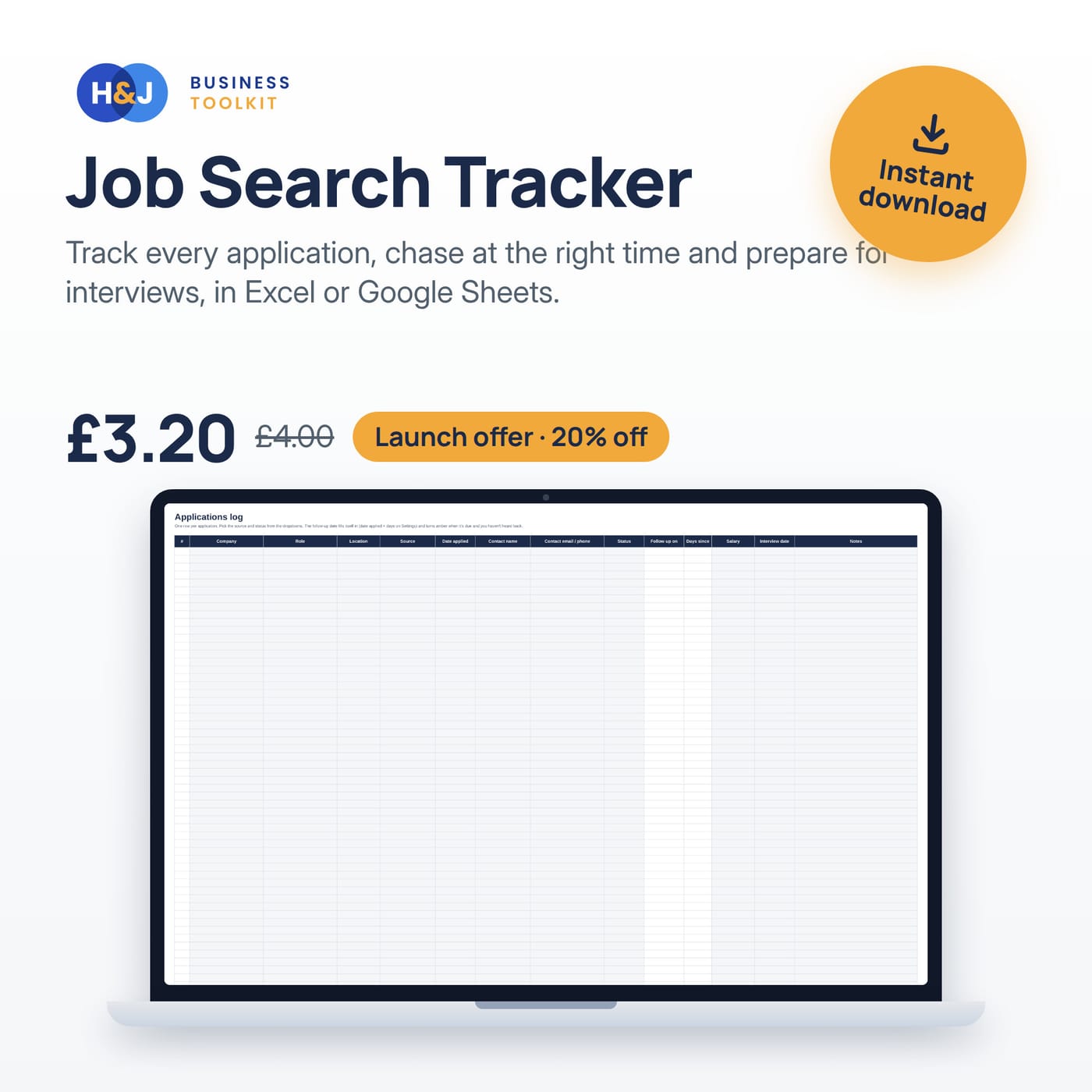 Careers
Job Search Tracker
Track every application, chase at the right time and prepare for interviews, in Excel or Google Sheets.
Price: £3.20
was £4.00Launch offer: 20% offExcel · Google Sheets
Keep reading
How to write a CV in the UK (with a free checklist)
What UK employers expect on a CV, section by section, what to leave out, how to beat applicant tracking systems, and a checklist to run before you send it.
How to make a 12-month cash flow forecast for a bank loan
Build a 12-month cash flow forecast a UK lender will take seriously: assumptions, payment timing, VAT and tax bills, and the checks to run first.
Gift vouchers for small businesses: how to sell and track them
How UK small businesses can sell gift vouchers profitably: what to print on them, fair terms, tracking redemptions, and VAT basics.
Get the free invoice template
A clean, UK-ready invoice for Excel and Google Sheets, plus occasional tips and new template news. Unsubscribe any time.
Your template is ready
We have also emailed the link to . Check your spam folder if it does not show up.
Download the template (.xlsx)For Google Sheets: upload the file to Drive and open it with Sheets. Trouble? Email support@hnjuk.co.uk.