
Times tables: how to prepare for the Year 4 multiplication check at home
What the Year 4 multiplication tables check involves, which tables matter most, and a calm 10-minutes-a-day times tables plan for home.
· 5 min read
Every Year 4 child in England takes the multiplication tables check (MTC) in June. It is short, it is on screen, and there is no pass mark, but it is still the moment many families realise that “knowing” the 7 times table and recalling 7 × 8 in a few seconds are not quite the same thing. The good news is that a little regular practice at home makes a real difference, and it does not need to be stressful for anyone.
What the check actually is
The MTC is a statutory assessment for pupils at the end of Year 4 in state-funded schools in England. The headline details:
- 25 questions, all multiplication, covering the 2 to 12 times tables.
- 6 seconds per question, with a 3-second pause between questions.
- Children type their answers on a computer or tablet, so it takes around five minutes in total.
- Schools run it during a set window in June.
- There is no pass mark. Each child gets a score out of 25.
The national curriculum expects children to recall multiplication and division facts up to 12 × 12 by the end of Year 4; the check is a way of measuring how fluent that recall is. Scores are used by schools and the government to see how well tables are being learnt. Ask your child’s school how and when they share individual results with families.
The official assessment framework says that the trickier tables, 6, 7, 8, 9 and 12, appear more often than the easier ones. That is useful to know: if time is short, that is where to spend it.
Recall, not working out
Six seconds is enough to type an answer you already know, but not enough to count up in sevens from 7 × 1. The aim of practice is to move facts from “I can work it out” to “I just know it”. That happens through short, frequent retrieval: being asked the fact, answering from memory, finding out straight away whether you were right, and coming back to the ones you got wrong.
Long sessions are not better. Ten minutes a day, five days a week, beats an hour on a Sunday.
A simple plan for home
Start by finding out what they already know
Give a mixed sheet of 2 to 12 questions without a time limit and mark it together. Note which tables are secure, which are slow and which are wrong. Most children are solid on 2, 5 and 10, wobbly on 3, 4 and 11, and genuinely stuck on a handful of facts in the 6, 7, 8 and 12 tables.
Learn one table at a time, using what they already know
Each new table is easier than it looks once you remove the facts already learnt:
- Turnarounds: 3 × 8 is the same as 8 × 3. Once the 2, 3, 4, 5 and 10 tables are secure, most of the 6, 7, 8 and 9 tables are already known the other way round.
- Doubling: the 4 times table is the 2 times table doubled; the 8 times table is the 4 times table doubled.
- Near facts: 9 × 7 is 10 × 7 minus 7. 11 × 7 is 10 × 7 plus 7. 12 × 7 is 10 × 7 plus 2 × 7.
- Patterns: the digits of the 9 times table add up to 9 (up to 9 × 10), and the tens digit goes up as the units go down.
When you count up what is genuinely new once turnarounds are taken out, the hard core of the 2 to 12 tables is surprisingly small. Write those facts on cards and make them the daily focus.
Practise in short bursts, mixed up
Once a table is learnt, mix it with others. Recalling 7 × 8 in a list of 7s is easier than recalling it in a random set, and the check is random. Ideas that work:
- Printed practice sheets: 40 questions, mixed tables, marked straight away against an answer sheet.
- Flashcards on the way to school or while dinner cooks, with the tricky ones going back into the pile.
- “Beat your score” games: same sheet, a few days apart, colour in a progress chart when they improve.
- Division facts too: if 7 × 8 = 56 is known, 56 ÷ 8 should be as well. Division is not in the check, but it strengthens recall.
Add timing gently, and late
Only introduce a timer once accuracy is high. Then use mock checks: 25 mixed questions, about six seconds each, with you reading the question and your child writing or saying the answer. Because the real check is typed, a little practice with a number keypad also helps children who are not used to one.
Keep the tone light. The check matters, but not enough to make tables something your child dreads.
A sample week
| Day | 10 minutes |
|---|---|
| Monday | Learn the focus facts for this week (no more than four or five) |
| Tuesday | Flashcards of the focus facts plus last week’s |
| Wednesday | Mixed practice sheet, mark it together |
| Thursday | Game or flashcards, focusing on Wednesday’s mistakes |
| Friday | Mixed sheet or mock check; colour in the progress chart |
Repeat with new focus facts each week. Most children who start in the autumn of Year 4 are fluent well before June.
When to worry, and when not to
Some children find recall genuinely hard, including many with dyslexia or dyscalculia. If practice is not sticking after several weeks, talk to the class teacher: schools can make access arrangements for the check, and they will have strategies that match how your child is taught in class. A low score is information for the school, not a judgement on your child.
Printable practice that matches the format
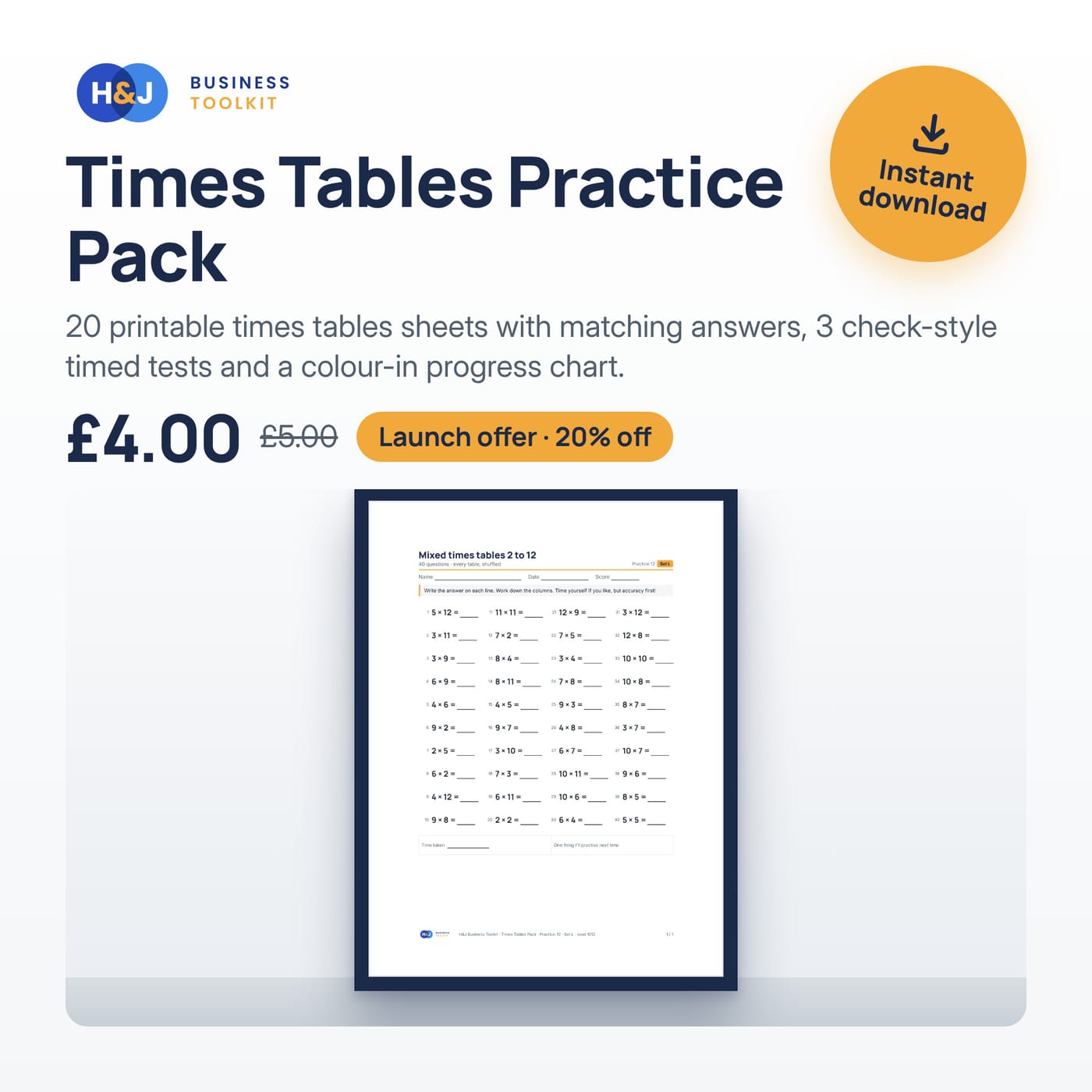
Our times tables practice pack has 20 printable sheets of 40 questions with matching answer sheets, three check-style timed tests of 25 questions and a colour-in progress chart. If you are thinking further ahead, the KS2 SATs-style practice pack covers Year 6 arithmetic, reasoning and grammar. Browse all our printable worksheets.
Our resources are original and not affiliated with the Standards and Testing Agency or the Department for Education.
Browse the templates
Templates that help
 Education
Times Tables Practice Pack
20 printable times tables sheets with matching answers, 3 check-style timed tests and a colour-in progress chart.
Price: £4.00
was £5.00Launch offer: 20% offPDF
 Education
KS2 SATs-Style Maths & Grammar Practice Pack
6 arithmetic papers, 3 reasoning sheets and 4 grammar sheets in the style of the Year 6 tests, all with answers.
Price: £6.40
was £8.00Launch offer: 20% offPDF
 Education
GCSE Revision Planner & Exam Countdown
Printable revision timetable, subject tracker, exam countdown and past-paper log, plus a spreadsheet that counts down the days.
Price: £3.20
was £4.00Launch offer: 20% offPDF · Excel · Google Sheets
Keep reading
How to make a 12-month cash flow forecast for a bank loan
Build a 12-month cash flow forecast a UK lender will take seriously: assumptions, payment timing, VAT and tax bills, and the checks to run first.
Gift vouchers for small businesses: how to sell and track them
How UK small businesses can sell gift vouchers profitably: what to print on them, fair terms, tracking redemptions, and VAT basics.
How to write a CV in the UK (with a free checklist)
What UK employers expect on a CV, section by section, what to leave out, how to beat applicant tracking systems, and a checklist to run before you send it.
Get the free invoice template
A clean, UK-ready invoice for Excel and Google Sheets, plus occasional tips and new template news. Unsubscribe any time.
Your template is ready
We have also emailed the link to . Check your spam folder if it does not show up.
Download the template (.xlsx)For Google Sheets: upload the file to Drive and open it with Sheets. Trouble? Email support@hnjuk.co.uk.